Find all editions of Cough Science News below and get access to the latest cough science developments, publications, and interviews with cough experts.
7 May 2026
Hello!
I've been going to the American Thoracic Society meeting for over 40 years. Fourteen thousand people at the same event, clinicians, drug developers, CROs, regulators, and every year you get a read on where the field has actually landed. This year the word that kept coming to mind was traction.
For a long time, cough was something the relatively small community of cough experts cared about and everyone else tolerated. What changed it - the combination of COVID making cough a public problem, drugs coming to market, and monitoring technology that actually works. Together these have put cough on the front of mind for any respiratory condition associated with cough.
Pop Quiz
What pulmonary diseases do not involve cough?
My list is very short…
You could see the increased interest in cough this year in Orlando. Pharma teams working across COPD, bronchiectasis, IPF, and sarcoidosis were coming to us with specific questions about trial design and not whether to include cough, but how. We were having sophisticated and nuanced discussions about Hawthorne effects on cough behavior, how to normalize a rolling baseline, what day-to-day variability means for your sample size calculation. That's a different discussion than we were having two years ago.
What came through in multiple independent conversations was the gap between what patients report and what continuous monitoring actually captures. A chronic cough sponsor we walked through our Hawthorne analysis engaged with it in a way that felt qualitatively different from past meetings, less about identifying opportunities and challenges, more working through them together. A number of folks who saw our COPD exacerbation data immediately started thinking about whether a rise in cough rate could serve as a clinical trigger for intensification of care.
These aren't incremental extensions of old thinking. They're people building new frameworks in real time and I’m glad that continuous cough monitoring is driving these conversations forward.

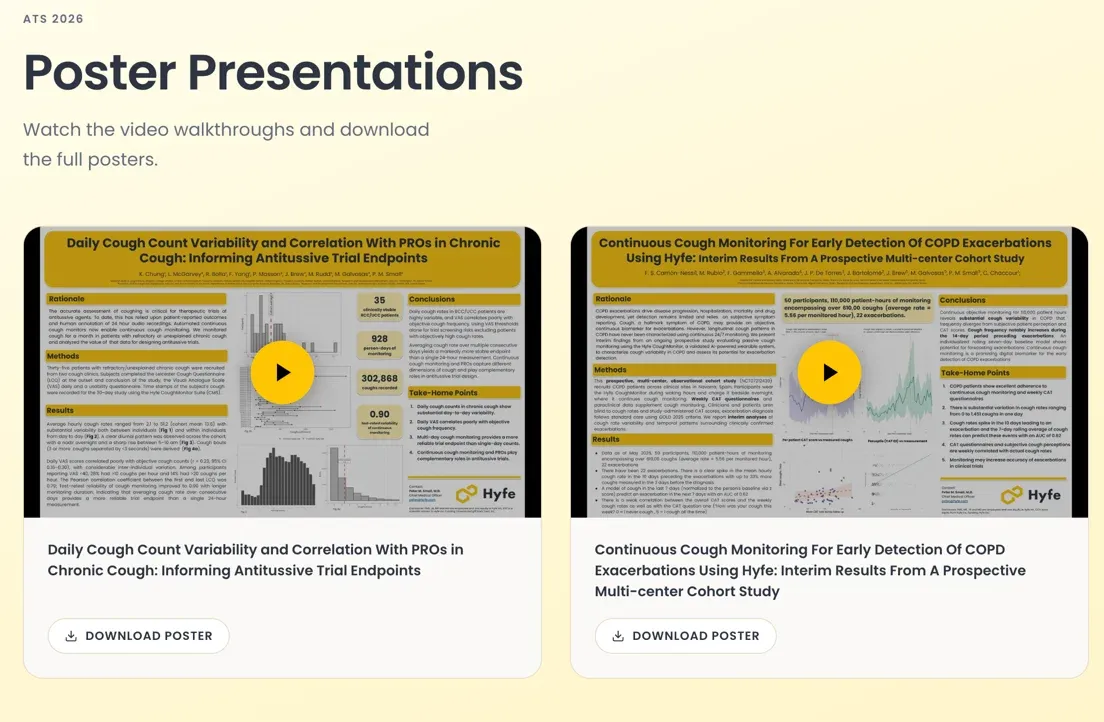
We presented two late-breaking posters this year. The full presentations are at science.hyfe.com, where we'll also be posting updates as these findings move toward publication.
POSTER 1: Continuous Cough Monitoring for Early Detection of COPD Exacerbations Using Hyfe: Interim Results From a Prospective Multi-Center Cohort Study
Interim results from 50 COPD patients followed prospectively in Spain: 110,000 patient-hours of monitoring, a half million coughs, 22 confirmed exacerbations…with practical implications for trial design and a clear spike in cough rate starting two weeks before an exacerbation. A rolling 7-day model predicts an exacerbation in the following week with an AUC of 0.62.
POSTER 2 Daily Cough Count Variability and Correlation With PROs in Chronic Cough: Informing Antitussive Trial Endpoints
35 patients with refractory or unexplained chronic cough monitored for 30 days. Daily VAS correlated poorly with objective cough counts (r = 0.23). Multi-day monitoring reaches a test-retest reliability of 0.90. If your trial design relies on a single 24-hour measurement or VAS screening alone, this data is worth checking out.
Both of these studies are ongoing, and the data keeps getting richer. Which brings me to something I want to flag for your calendar
On July 1st at 9am PT/12pm ET/5pm BST, we're restarting the Cough Science Forum, a scientific webinar series where researchers present their work on cough monitoring across disease areas. The theme for this session is the temporal dynamics of cough: how cough behaves over time, how it varies within and between individuals, and what that looks like across different diseases.
We will be looking into data for chronic cough, COPD, and pediatric asthma.
If you'd like to attend, please register your interest on the link below.
What the study found: A survey of 197 patients with chronic cough from the US Pulmonary Fibrosis Foundation's Community Registry, 76% with IPF. Cough had been present for two or more years in 76% of respondents, and 61% reported it had worsened since onset. Only 11% reported effective relief from treatment. 96% worried about their cough, 75% felt it contributed to depression, sadness, or low mood, 67% avoided social situations because of it, and 61% felt it had damaged relationships with family, friends, or colleagues.
Why it matters: The numbers here are sobering. We spend a lot of time talking about cough as an endpoint in ILD trials, which is right, but this survey is a reminder of what is actually happening to patients while we measure it. Any drug that meaningfully reduces cough in IPF or ILD is not just hitting an endpoint. It is addressing something patients are quietly suffering through every day, in ways that standard disease measures don't capture. The 11% treatment relief figure alone should be read as an open invitation.
What the study found: A UCSF team applied a structured scoring framework to evaluate ten candidate home monitoring components for early detection of clinically significant events in ILD, defined as acute exacerbation, hospitalization, or 10% or greater decline in FVC over three months. Seven criteria were weighted and scored across all components. Electronic PROs and spirometry led the rankings. Continuous cough monitoring scored 3.70 out of 5, ranking fifth overall and standing out for its high incremental value score. It will advance into the next phase alongside PROs, spirometry, oximetry, and weight in a randomized factorial design.
Why it matters: What I find useful about this paper is not the score itself but the methodology behind it. Someone sat down and asked which monitoring tools actually earn their place in ILD care, using a reproducible framework rather than intuition. Cough monitoring made the cut on incremental value, meaning it adds something the other tools don't. That's the argument we've been making, and it's good to see it reflected in an independent, NIH-funded evaluation. The next phase will generate real comparative data. Worth watching.
What the study found: CoughRetrain is a five-session telehealth behavioral program for RCC combining education, graded cough suppression practice, laryngeal techniques, and motivational interviewing. Eleven patients completed it. LCQ scores improved by 3.6 points and 24-hour objective cough frequency fell by 48%. Cough-specific self-efficacy improved while general self-efficacy stayed flat, consistent with the program’s targeted focus on cough inhibitory control.
Why it matters: Another proof point that behavioral cough suppression therapy works remotely. The LCQ improvement is more modest than what we’re seeing in other telehealth BCST studies, but the 48% reduction in objective cough frequency is notable. This is more evidence that behavior cough suppresion therapy can be delivered digitally and should play a role in cough management either alone or in combination with new antitussive drugs.
I'm very excited about the upcoming Cough Science Forum. We'll send more details soon!
Until next month,
Peter Small, MD
Chief Medical Officer, Hyfe
