Find all editions of Cough Science News below and get access to the latest cough science developments, publications, and interviews with cough experts.
5 November 2025
Key Takeaways
This narrative review finds that AI-enabled continuous cough monitoring (CCM) can quantify cough burden and variability over days to weeks in real-world settings, yielding insights across RCC/UCC, COPD, bronchiectasis, heart failure, and reflux, and supporting use as a sensitive endpoint in trials and even syndromic surveillance. It also compares current platforms and notes that, as of April 2025, none has specific FDA clearance for cough counting.
Why It Matters
CCM is moving cough from a subjective symptom to a measurable digital biomarker, with potential for earlier deterioration detection and more rigorous drug development. For routine adoption, the review highlights the need for regulatory pathways and standardization (e.g., monitoring duration, event definitions, wear handling) to ensure comparable and clinically actionable data.
Key Takeaways
Findings in this cohort study of 427,555 individuals who were prescribed a GLP-1RA and 1,614,495 matched individuals who were prescribed a different second-line diabetes medication, GLP-1RA treatment was associated with a higher adjusted hazard ratio of new chronic cough. This association was independent of gastroesophageal reflux disease diagnosis.
Why It Matters
The study findings suggest that patients who use GLP-1RAs have an increased risk of chronic cough, suggesting further exploration of the strength of this association and pharmacologic mechanisms.
Key Takeaways
A 2025 scoping review (77 studies) maps five real-world applications: diagnosis, severity assessment, treatment monitoring, health-outcome prediction, and syndromic surveillance, but finds limited clinical validation so far. Objective cough frequency shows only moderate correlation with patient-reported cough severity (median r = 0.42, IQR 0.38 to 0.59) and cough-related quality of life (median r = −0.49, IQR −0.63 to −0.44), underlining how complex the relationship is between measurable cough counts and how patients actually feel.
Why It Matters
PROs alone cannot reliably quantify coughing. Because subjective perception and objective cough frequency measure different aspects of the symptom, PROs should be complemented by objective cough counting to provide a complete and accurate picture, especially for assessing severity, monitoring treatment response, or predicting clinical deterioration.
Key Takeaways
In a cross-sectional study of stable COPD outpatients (26 with PSG; 17 with OSA), cough sound features recorded on an audio-enabled smartwatch correlated most strongly with OSA diagnosis (e.g., MFCC-based feature r≈−0.66). A logistic model using a single cough-sound subfeature classified OSA with 92% accuracy (sensitivity 88.2%, specificity 100%; AUC 0.89); a separate model combining HRV, exhalation, and cough features explained ~52% of AHI variance.
Why It Matters
COPD–OSA overlap is high-risk yet under-recognized; if validated, wearable cough acoustics could offer a low-burden screen to triage COPD patients for formal sleep testing. The authors note limitations (small sample, no pure-OSA control, voluntary, not spontaneous, coughs), so larger, device-agnostic, prospective studies are needed.
Plus:
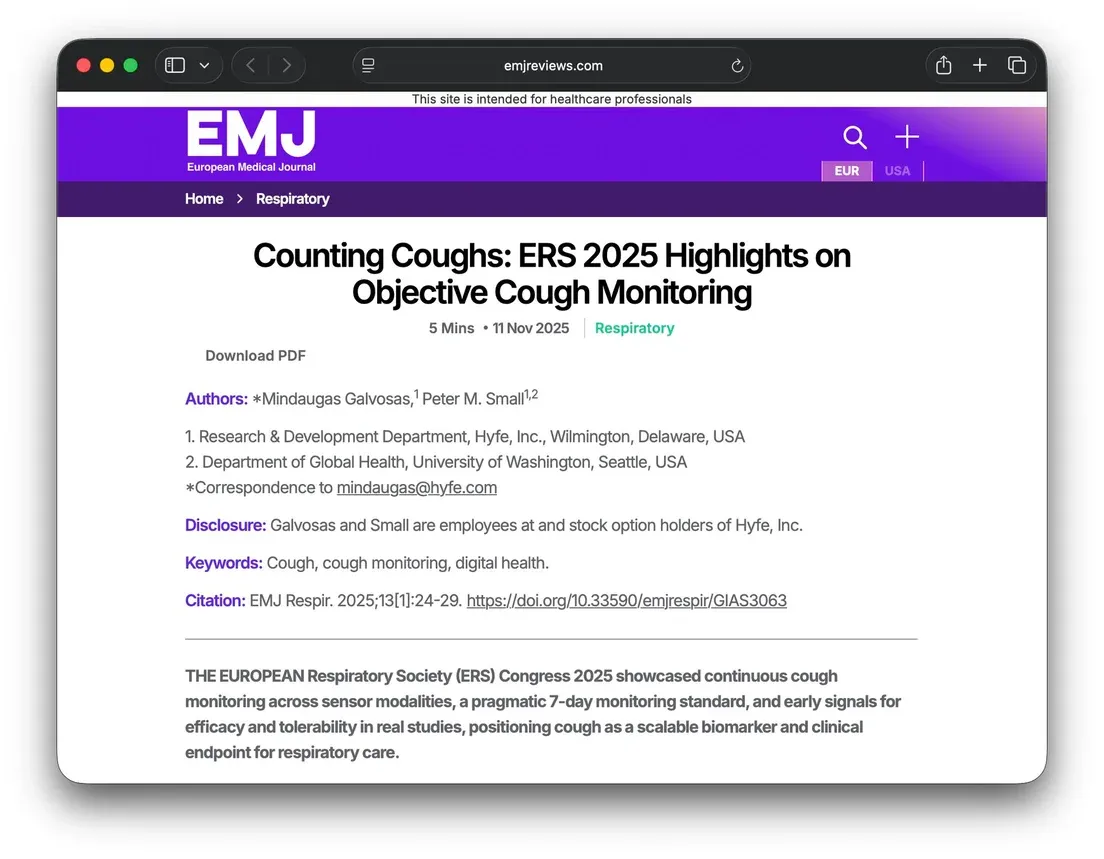
Counting Coughs: ERS 2025 Highlights on Objective Cough Monitoring
Why cough and cough monitoring, and why now? 👇
Read our key insights from ERS2025 at EMJ - highlighting the latest objective cough monitoring technologies (Strados Labs, C-mo Medical Solutions, Hyfe, Vitalograph, SIVA Health), insights from scientific presentations on optimal cough monitoring duration, cough statistics, cough bouts, and applications of cough monitoring as signals of efficacy and tolerability.
$1.4B
US healthcare spend on healthcare-specific generative AI in 2025
22%
US healthcare organizations with domain-specific AI tools in production in 2025
$9.94B
Digital therapeutics market size in 2025, projected to reach $61.29B by 2034
Upcoming Cough Science Events
International Cough Conference (China, 2025) 2025年国际咳嗽会议 in Guangzhou, China, December 5th - 6th. Hyfe’s collaborators will be presenting insights from continuous cough monitoring with Hyfe’s CoughMonitor Suite. If you have any questions - contact Hyfe’s Chief Medical Officer Dr. Peter Small peter@hyfe.com
