Get expert insights into cough science, monitoring and research

Recent advances in bronchiectasis (BE) therapeutics have drawn attention to clinical trial endpoint selection. Although exacerbation rate and lung function remain central to clinical trials, chronic productive cough is recognized as the defining symptom of BE and a major contributor to patients' daily disease burden and impaired quality of life. However, in clinical trials, cough continues to be assessed predominantly through subjective recall, limiting the accurate evaluation of symptom burden. As new mechanism-based therapies emerge and the field continues to refine its endpoint strategies, objective, continuous cough monitoring represents a strategic quantitative approach to complement existing outcome measures.
BE is entering a period of renewed therapeutic momentum. Growing disease awareness and a deeper understanding of disease biology are reshaping the clinical pipeline, shifting treatment strategies from symptom management toward therapies that target specific disease mechanisms(1–3). As BE research becomes more sophisticated, clinical trial endpoints must also evolve to capture the full spectrum of treatment benefits(4).
Exacerbation rate and lung function remain the foundation of BE trials. Exacerbations are clinically meaningful events that are associated with disease progression, lung function decline, hospitalization, and increased mortality(5). However, they represent episodic disease activity and do not reflect the day-to-day burden experienced by most patients6. In this context, the daily burden of cough and sputum production is perceived by patients as an equal or greater concern than exacerbations(6).
This disconnect between what patients experience and what clinical trials measure has become increasingly apparent. Across three randomized trials, patients who improved on one endpoint were not reliably those who improved on another, and no clinical characteristics distinguished responders from non-responders(7). At the same time, evidence also suggests that symptom burden itself has prognostic value. Studies show patients with higher symptom burden are at a greater risk of exacerbations, and treatment benefits have been observed primarily in the highly symptomatic subgroup(8). Together, these findings suggest that symptomatic improvement is an important treatment outcome, and conventional endpoints alone may not adequately evaluate the benefits of mechanism-based therapies.
The obvious response is to measure symptoms better, and here the field runs into a second problem: the existing instruments are not trusted to carry that weight. Placebo arms in BE trials show large apparent gains on quality-of-life instruments. In one reanalysis, between a quarter and more than half of participants in placebo arms scored above the minimum clinically important difference (MCID)(7). Regulators have been unenthusiastic about quality of life as a primary endpoint, and even its advocates concede that while symptoms would ideally be the primary endpoint, confidence in the current tools is insufficient to recommend one(6). Recognizing this need, international initiatives such as The European Multi-centre Bronchiectasis Audit and Research Collaboration (EMBARC) continue to refine recommendations for endpoint selection and outcome measurement in bronchiectasis. This work creates an opening for objective, treatment-responsive measures.
Chronic productive cough is a defining feature of BE and is one of its greatest contributors to impaired quality of life (QoL)(9). However, in BE trials it is still assessed predominantly using recall-based patient-reported outcome (PRO) measures, which are inherently susceptible to recall bias and day-to-day variability. As trials increasingly aim to demonstrate symptomatic benefit alongside exacerbation reduction, objective cough frequency offers a quantitative measure of daily disease burden that can complement established endpoints and better reflect the patient experience.
As more and more respiratory trials adopt objective measures of disease activity, continuous cough monitoring is emerging as a promising approach for quantifying symptom burden(10). Its clinical relevance is supported by experience in other chronic respiratory diseases, such as Chronic Obstructive Pulmonary Disease (COPD), sarcoidosis and tuberculosis, where cough frequency and temporal patterns have been associated with disease burden, providing a strong rationale for its evaluation as a complementary endpoint in bronchiectasis(11–14).
Unlike recall-based PRO measures, ambulatory cough monitoring continuously measures cough frequency during patients' normal daily activities. The development of fully automated cough monitoring systems has made this feasible at scale(15) and validated cough counting technologies are already supporting clinical research and drug development for several indications.
Hence, in BE trials, these technologies can complement subjective recall PROs, being sensitive enough to detect treatment effect earlier and with reduced sample sizes. They also minimize participant burden, making them well suited to multicentre and decentralized clinical trials.
The growing body of evidence in BE supports the clinical utility of objective cough monitoring. Studies have shown that cough frequency is measurable, clinically meaningful, and associated with disease activity, justifying its inclusion in future endpoint strategies(9,14,16).
The strongest evidence comes from the landmark study by Spinou et al., which was the first to characterize 24-hour objective cough frequency comprehensively in patients with BE9. The study showed that patients coughed nearly nine times as often as healthy controls (184.5 vs. 20.6 coughs/24h; p<0.001), with 84% exceeding published normal ranges, and significantly higher cough counts in patients with chronic sputum production. In addition, it was observed that daytime cough counts were significantly greater than night-time. More importantly, objective cough frequency correlated closely with health-related QoL, particularly the Bronchiectasis Health Questionnaire (BHQ), but not with lung function. Age, sputum production, and antibiotic-treated exacerbations were independent predictors of cough frequency.
Building on these observations, Griffith and colleagues subsequently demonstrated the feasibility of continuous cough monitoring in routine airway clearance therapies. Among the five patients with continuous monitoring data, all showed a 43–78% reduction in cough frequency over the first four days of treatment(16). The continuous passive cough monitoring device was able to effectively detect the treatment-related changes in real time(16). These findings further highlight that cough is a dynamic physiological signal that can provide insights into treatment responses that are difficult to capture using symptom questionnaires or clinic-based assessments.
Figure 1. Left panel: Daily average of hourly cough counts in bronchiectasis patients with significant cough over the course of their airway clearance program Right panel: Cough monitoring results displayed in hourly increments showing the timing of cough-inducing interventions including hypertonic saline sputum induction (blue), hypertonic saline and Aerobika combined with hypertonic saline (purple) and vest trials (green)
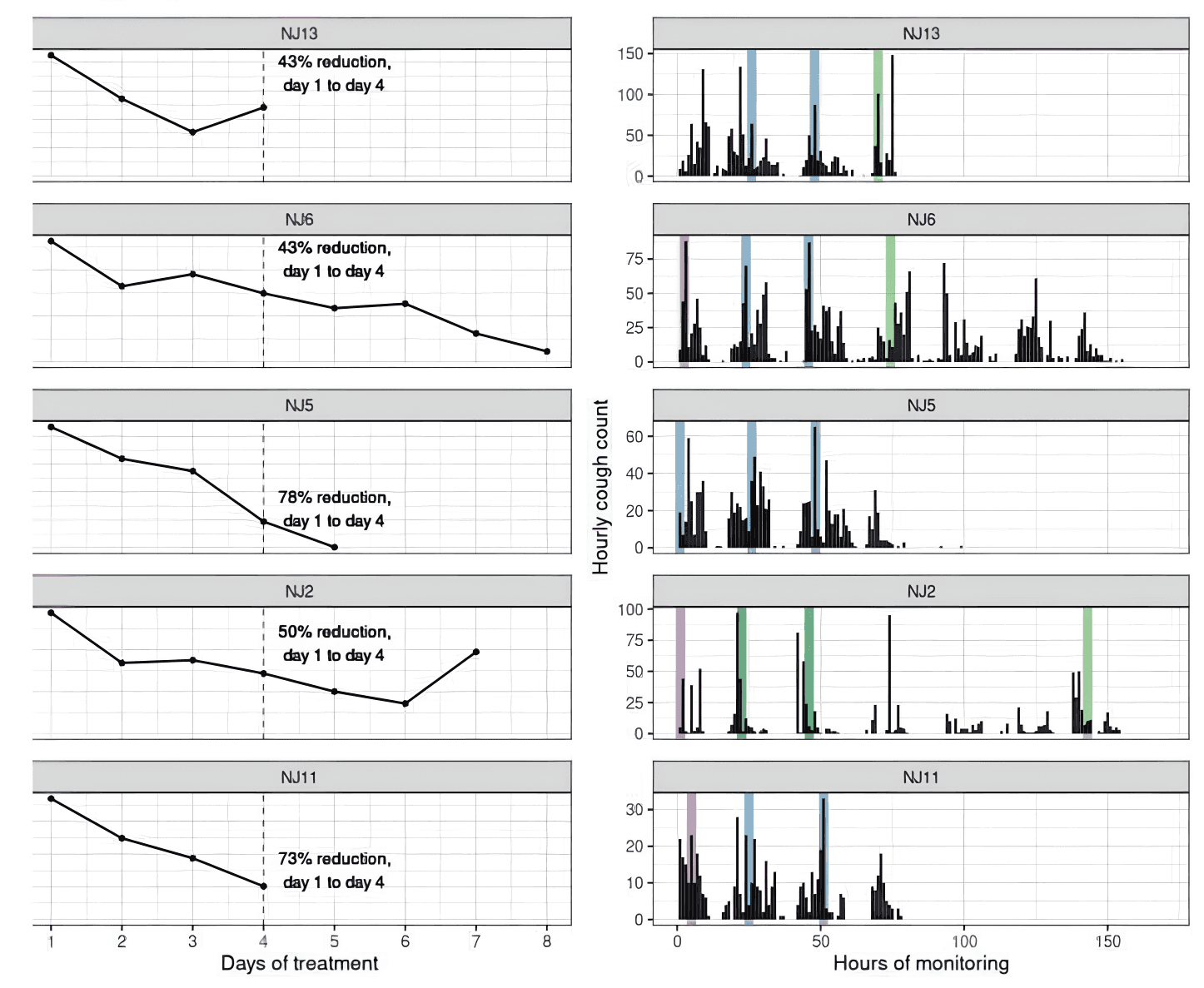
In trials, therefore, “how cough is measured” becomes very important. Cough is inherently variable both overall cough rates between subjects and day-to-day within subjects. Episodic assessments or recall-based questionnaires capture only a brief snapshot of the within-subject day-to-day variability and are prone to bias. Continuous ambulatory monitoring captures 24/7, as cough occurs in everyday life. A seven-day monitoring period was found to provide reliable estimates of hourly cough averages and variances.
This provides a more accurate measure of cough burden. For clinical trials, this translates into greater sensitivity for detecting treatment effects and improved statistical power.
Objective cough monitoring has been incorporated into clinical trials across several respiratory diseases, providing an important precedent for BE.
Collectively, these studies demonstrate that the analytical methods and validation frameworks are already in place, further supporting the feasibility and clinical relevance of continuous cough monitoring in BE trial designs.
BE is at a pivotal point in its clinical development. Its endpoint framework is still evolving and not yet standardized, creating a window to shape how future trials will measure treatment benefit. Currently, cough remains an exploratory, nonstandard endpoint in this therapeutic area, which makes this the right moment to introduce objective cough measurement and shape the outcome strategies. This is driven by the growing recognition that symptom burden is an important treatment goal and should be measured to reflect treatment benefit.
Although objective cough monitoring has gained experience in other respiratory diseases, several challenges remain in BE. Continuous cough monitoring is not yet a qualified endpoint, and there is currently no agreed minimal clinically important difference (MCID) to guide interpretation. In addition, distinguishing productive cough presents greater technical challenges for automated cough characterization. These are genuine gaps, but they reinforce the need for disease-specific validation, analytical refinement, and prospective incorporation into clinical trials.
As the therapeutic pipelines seek to modify the underlying disease process by mechanisms such as reducing airway inflammation, interrupting the cycle of mucus hypersecretion, and improving mucociliary clearance1,3, it is plausible that objective measures can quantify whether these mechanistic changes translate into meaningful improvements in daily cough burden. Therefore, integrating continuous cough monitoring now can strengthen endpoint strategies with a measure that is clinically relevant, technically feasible, as well as, meaningful to patients.
Objective cough monitoring is not intended to replace the established efficacy endpoints, namely exacerbation rate or lung function. Its value lies in complementing them with an objective, quantitative assessment of symptom benefit, strengthening the overall evidence package and providing a more complete picture of treatment effect.
For sponsors, this extends beyond endpoint selection. Incorporating objective cough monitoring into bronchiectasis trials offers an opportunity to generate disease-specific evidence of symptomatic benefit that can inform future trial design and support labelling claims. This can also strengthen the overall clinical value proposition, offering an important point of differentiation in an increasingly competitive landscape.
1. Tramontano A, Caporaso M, Macciocchi G, Simonetta E, Nigro M, Aliberti S. New Perspectives in the Treatment of Bronchiectasis. Arch Bronconeumol. Published online January 9, 2026. doi:10.1016/J.ARBRES.2025.12.008
2. Flume PA, Polverino E. Making real progress in the world of bronchiectasis. J Thorac Dis. 2025;17(8):5414-5416. doi:10.21037/JTD-2025-180/PRF
3. Choi H, McShane PJ, Aliberti S, Chalmers JD. Bronchiectasis management in adults: state of the art and future directions. Eur Respir J. 2024;63(6):2400518. doi:10.1183/13993003.00518-2024
4. Crichton ML, Aliberti S, Chalmers JD. A systematic review of pharmacotherapeutic clinical trial end-points for bronchiectasis in adults. European Respiratory Review. 2019;28(151):180108. doi:10.1183/16000617.0108-2018
5. Lapinel NC, Choate R, Aksamit TR, et al. Characteristics of exacerbators in the US Bronchiectasis and NTM Research Registry: a cross-sectional study. ERJ Open Res. 2024;10(6):00185-02024. doi:10.1183/23120541.00185-2024
6. Metersky M, Chalmers J. Bronchiectasis insanity: Doing the same thing over and over again and expecting different results? F1000Res. 2019;8:F1000 Faculty Rev-293. doi:10.12688/F1000RESEARCH.17295.1
7. Sibila O, Laserna E, Shoemark A, et al. Heterogeneity of treatment response in bronchiectasis clinical trials. European Respiratory Journal. 2022;59(5). doi:10.1183/13993003.00777-2021
8. Gao YH, Leyah HA, Finch S, et al. Relationship between Symptoms, Exacerbations, and Treatment Response in Bronchiectasis. Am J Respir Crit Care Med. 2020;201(12):1499-1507. doi:10.1164/RCCM.201910-1972OC
9. Spinou A, Lee KK, Sinha A, et al. The Objective Assessment of Cough Frequency in Bronchiectasis. Lung. 2017;195(5):575. doi:10.1007/S00408-017-0038-X
10. Chaccour C, Sánchez-Olivieri I, Siegel S, et al. Validation and accuracy of the Hyfe cough monitoring system: a multicenter clinical study. Sci Rep. 2025;15(1):880. doi:10.1038/S41598-025-85341-3
11. Sumner H, Woodcock A, Kolsum U, et al. Predictors of objective cough frequency in chronic obstructive pulmonary disease. Am J Respir Crit Care Med. 2013;187(9):943-949. doi:10.1164/RCCM.201211-2000OC
12. Sinha A, Lee KK, Rafferty GF, et al. Predictors of objective cough frequency in pulmonary sarcoidosis. Eur Respir J. 2016;47(5):1461-1471. doi:10.1183/13993003.01369-2015
13. Turner RD, Bothamley GH. Cough and the transmission of tuberculosis. J Infect Dis. 2015;211(9):1367-1372. doi:10.1093/INFDIS/JIU625
14. Spinou A, Garrod R, Lee K, et al. P8 Objective Cough Frequency Monitoring In Bronchiectasis. Thorax. 2014;69(Suppl 2):A80-A81. doi:10.1136/THORAXJNL-2014-206260.158
15. Galvosas M, Small PM. The value of continuous cough monitoring: a narrative review. J Thorac Dis. 2025;17(11):10571-10583. doi:10.21037/JTD-2025-876/PRF
16. Griffith DE, Levin AR, Rudd M, Small P, Daley CL. Using Continuous Cough Monitoring to Assess Bronchiectasis Therapy. Am J Respir Crit Care Med. 2024;209(Supplement_1):A7084-A7084. doi:10.1164/AJRCCM-CONFERENCE.2024.209.1_MEETINGABSTRACTS.A7084
17. Wu Z, Banya W, Chaudhuri N, et al. PAciFy Cough—a multicentre, double-blind, placebo-controlled, crossover trial of morphine sulphate for the treatment of pulmonary Fibrosis Cough. Trials. 2022;23(1):184. doi:10.1186/S13063-022-06068-4
18. Smith JA, Carroll KJ, Clark D, Molyneaux PL. Change in Objective Cough Count Correlates With Improvement in Patient-Reported Outcomes of Cough in Patients With Idiopathic Pulmonary Fibrosis. Published online 2024.