Research and Publications
53
Research Trials
20
Peer-reviewed publications
16
Clinical Conditions
53
Research Trials
20
Peer-reviewed publications
16
Clinical Conditions

At CHEST 2025, held in Chicago, Illinois, Laurie Slovarp, PhD, CCC-SLP, professor at the University of Montana and certified speech pathologist, presented a poster on the development of a digital therapeutic designed to improve access to behavioral cough suppression therapy for patients with refractory chronic cough.

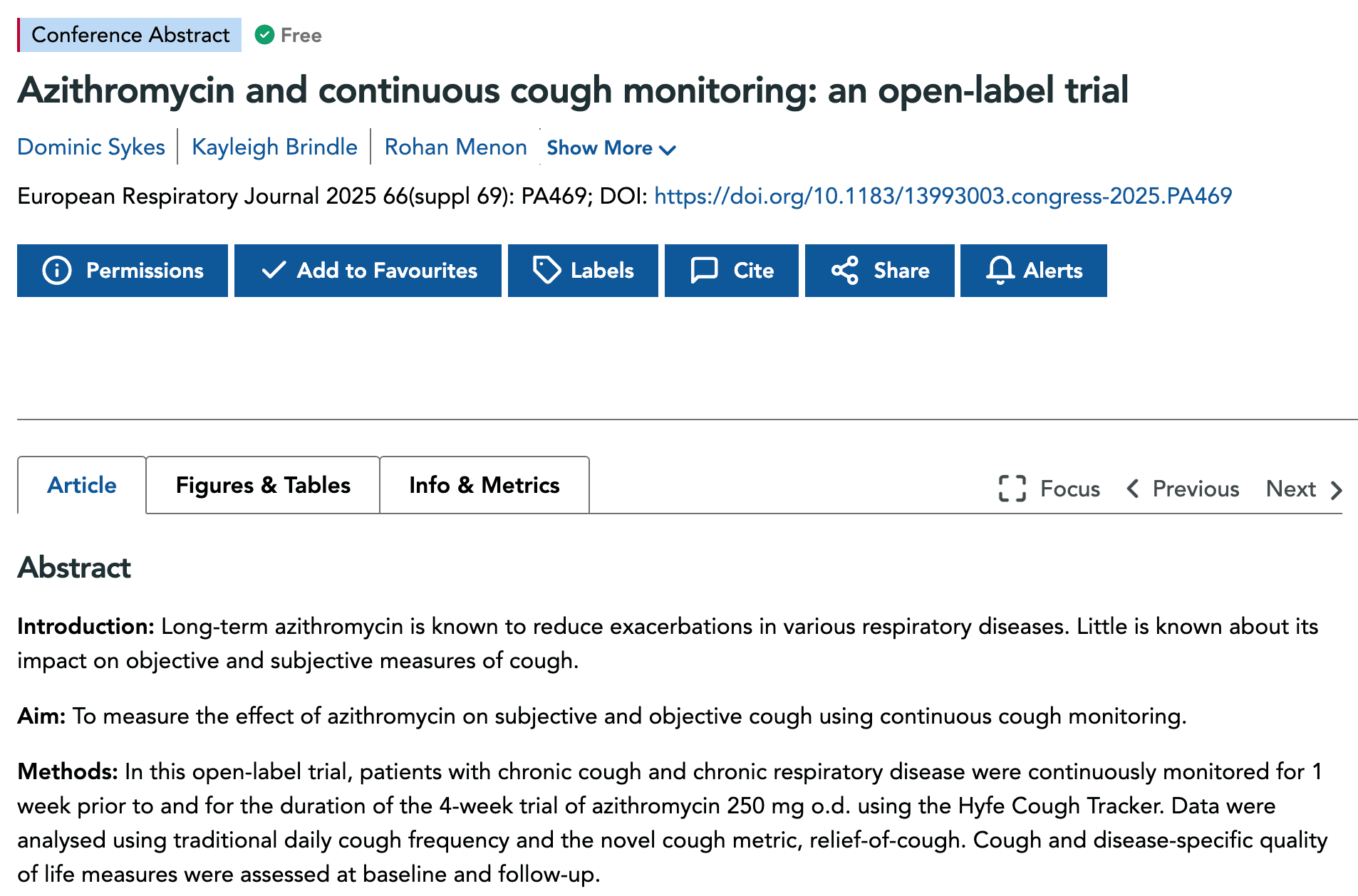
A large-scale trial examining the effect of azithromycin on the relationship between oesophageal function and cough as evaluated by Hyfe's cough monitoring technology in respiratory disease is feasible and acceptable to patients.

This study used Hyfe's wearable cough monitor during a 7-day run in, 28-day treatment, and 14-day follow-up period in patients with chronic bronchitis.

Periods of intense coughing (termed bouts, epochs or bursts) are particularly problematic for some coughers and may not be reflected by simply counting the number of coughs per day. This study explored how varying the definition of bouts yield different impressions of cough severity.

The world’s first DTx for Refractory/Unexplained Chronic Cough (RCC/UCC). What it is? Digitally delivered behavioral cough suppression therapy (BCST), designed for high engagement to promote strong adherence. It includes continuous, passive cough monitoring and biofeedback loop enabling tailored personalization.

A 7-day monitoring duration provides a robust, standardized timeframe for assessing cough frequency in clinical studies, offering a significant improvement over the traditional 24-hour period. This duration captures inter- and intra-individual cough variability.

This analysis of cough events demonstrated that the Hyfe CoughMonitor smartwatch, compared to a human listener, accurately detects coughs, with high sensitivity and a low false positive rate. Future studies should focus on its potential role in the management of patients with cough in clinical practice.

The article presents a dataset of 733,756 cough sounds from 2,143 patients across 7 countries, accompanied by accurate demographic, clinical, and microbiological diagnostic annotations. It was collected using an early version of Hyfe’s research application, specifically designed to capture cough audio.

This is an exploratory, single-blind, nasal saline-controlled study involving 12 patients with refractory chronic cough, designed to examine the cough suppression efficacy of alkaline salts, monitored objectively with the previous version of the Hyfe CoughMonitor Suite.

A single-blinded study in 12 chronic cough patients evaluated the cough-suppression efficacy of nasally delivered SC001 (pH 8 or 9) versus saline. Using Hyfe CoughMonitor, patients were monitored over three weeks. Results suggest alkaline (pH 9) SC001 aerosol shows promise for refractory chronic cough treatment.

A 30-day study of 12 chronic cough patients found no correlation between daily cough counts (median: 93/day) measured by the Hyfe CoughMonitor and symptom severity assessed via the Cough VAS. Further research is needed to identify better endpoints for evaluating chronic cough treatments.

Coughing frequencies vary significantly between and within individuals, for those with a cough frequency of >5 coughs/h. One 24-hour measurement of cough does not reliably reflect long-term trends in up to half of those with persistent cough. This work provides methodological direction for subsequent definitive studies

The Hyfe Cough Monitor System accurately monitors coughing in problematic coughers as they go about their usual daily activities. The ability to continually and passively monitor cough has the potential to improve patient care, cough research and drug development.

This pilot work clarifies a methodology for quantifying this phenomenon and provides preliminary evidence that non-user coughs have a negligible effect on the cough estimates of the Hyfe Cough Monitor Watch in real-world settings.

An earlier version of Hyfe’s cough monitoring technology was used to monitor cough for 6 months in this study with patients with pulmonary tuberculosis. Community-based continuous cough monitoring for pulmonary tuberculosis is feasible in low-resource settings.

97 persistent coughers with at least 5 coughs/h were monitored for >20h a day for 30 days in real world environments using Hyfe - 2/3rds of them do not cough like metronomes

This is the first report demonstrating the feasibility of continual cough monitoring to assess the clinical impact of bronchiectasis therapy. The average rate of cough decreased significantly in all patients, suggesting that the airway clearance protocol at National Jewish is effective in rapidly reducing coughing.

Over the 477 hours monitored, 4102 cough-seconds were recorded from the 20 subjects; the CoughMonitor detected 3715 of these (overall sensitivity 90.57%) and had 520 false positives (overall false positive rate of 1.09 false positives per hour).

Continuous passive cough monitoring demonstrates the heterogeneous and stochastic pattern of persistent cough and that 24 hour counts often inaccurately reflect longer term cough rates.

In this pilot study, we were able to collect coughs in the course of routine patient workflows and demonstrate that AI enabled algorithms are predictive of which individuals are likely to have an abnormal CXR.

The recent advances in digital and wearable technologies with artificial intelligence (AI) enable the use of continuous cough monitoring (CCM) to objectively monitor symptoms as surrogate markers of treatment efficacy in pulmonary tuberculosis (PTB). The objectives of this study are to describe the evolution of cough during PTB treatment in adult and to assess the feasibility of community-based CCM.
We prospectively enrolled PTB adult participants upon treatment initiation. Participants’ coughs were continuously monitored during 6 months with a smartphone loaded with an app able to detect cough by using an AI algorithm.
wenty-two participants were included. The median age was 28.5 (IQR: 22–42) and 62% were male. The median cough per hour (medCPH) was 11.0 (IQR: 7.0–27.0) at week 1. By the end of the intensive phase of PTB treatment at week 8, the medCPH was 3.5 (IQR: 1.5–7.0), which was significantly lower than the medCPH at week 1 (p=0.002). At week 26 (end of treatment), the medCPH was 1.0 (IQR: 1.0–2.5). The adherence to CCM was high during the first 13 weeks of PTB treatment and then waned over time. The adherence was similar during daytime and nighttime.
Cough counts rapidly drop during the intensive phase of PTB treatment and then slowly decrease to a low baseline level by the end of the treatment. Community-based CCM using digital technology is feasible in low resource settings.

At CHEST 2025, held in Chicago, Illinois, Laurie Slovarp, PhD, CCC-SLP, professor at the University of Montana and certified speech pathologist, presented a poster on the development of a digital therapeutic designed to improve access to behavioral cough suppression therapy for patients with refractory chronic cough.

A large-scale trial examining the effect of azithromycin on the relationship between oesophageal function and cough as evaluated by Hyfe's cough monitoring technology in respiratory disease is feasible and acceptable to patients.

This study used Hyfe's wearable cough monitor during a 7-day run in, 28-day treatment, and 14-day follow-up period in patients with chronic bronchitis.

Periods of intense coughing (termed bouts, epochs or bursts) are particularly problematic for some coughers and may not be reflected by simply counting the number of coughs per day. This study explored how varying the definition of bouts yield different impressions of cough severity.